
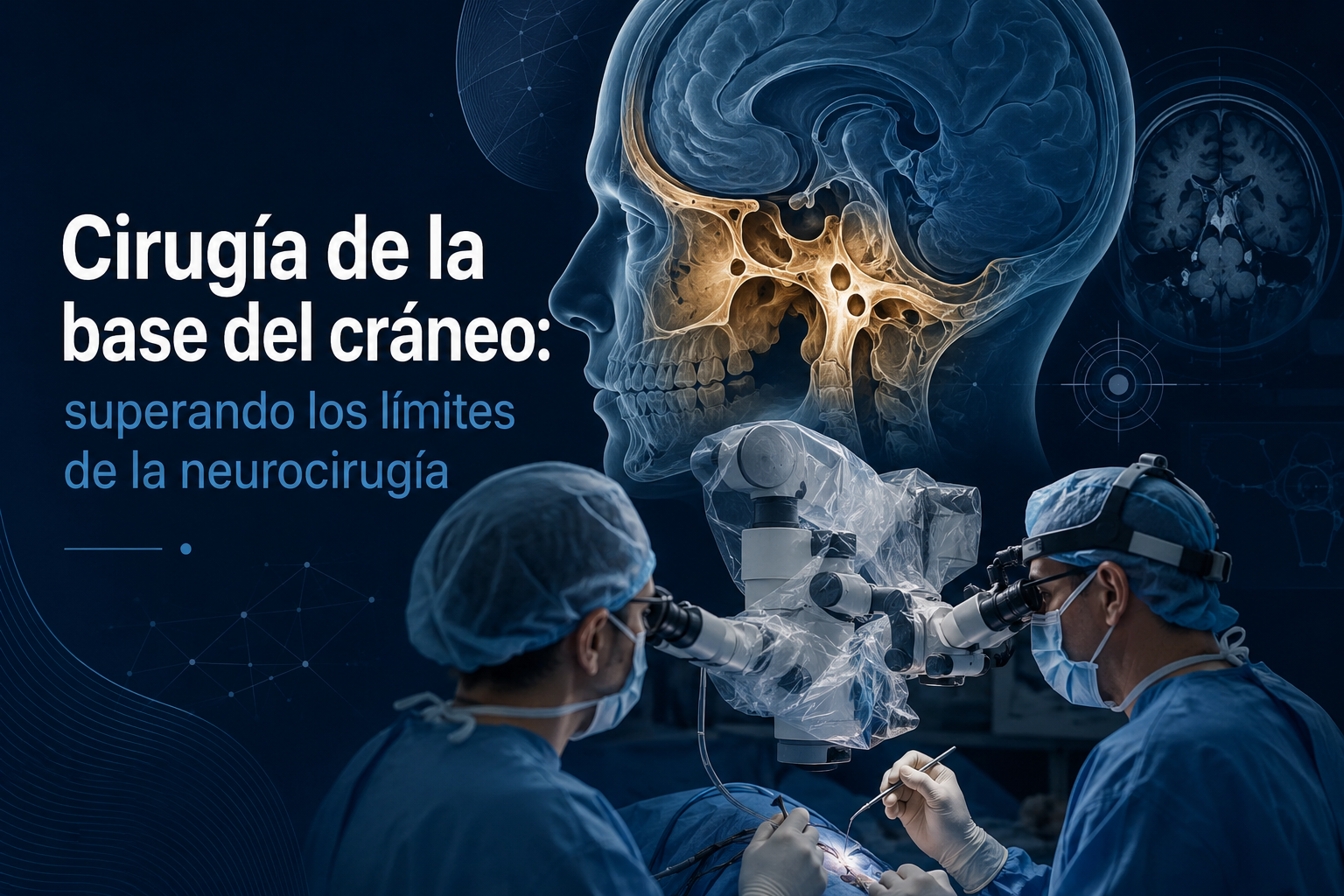
The base of the skull is one of the most complex and delicate regions of human anatomy. It is the bony structure that separates the brain from the paranasal sinuses, orbits, ears, and cervical spine. In this confined space, vital arteries, major draining veins, and the twelve pairs of cranial nerves converge, controlling essential functions such as vision, eye movement, hearing, balance, and swallowing. At the Arráez Institute, under the direction of Dr Miguel Ángel Arráez, We specialise in the treatment of pathologies in this critical area, where surgical precision is the only guarantee of success.
Brain tumours, such as Pituitary adenomas, meningiomas, acoustic neuromas, or chordomas, present an extraordinary technical challenge. Their proximity to fundamental neurovascular structures means that their approach requires highly specialised training and the use of cutting-edge technology.
Endoscopic and open approaches in skull base surgery
Modern neurosurgery has evolved towards increasingly less invasive techniques, allowing access to deep lesions through natural orifices or via minimal incisions. At Arráez Institute, we select the most appropriate approach for each patient, always prioritising safety and functional preservation.
Endoscopic endonasal surgery: access through the nose
One of the most significant advancements is extended endoscopic endonasal approaches. This technique uses the nasal passages as a natural corridor to reach the skull base and the sellar region (where the pituitary gland is located). Using.
Skull base microsurgery: precision open approaches
For tumours located in the anterior, middle or posterior cranial fossa that are not accessible via the endonasal route, we employ open microsurgical approaches. These techniques require meticulous planning and the use of state-of-the-art surgical microscopes that provide exceptional illumination and magnification. The key to these procedures lies in microsurgical dissection, separating the tumour from nerves and blood vessels with extreme delicacy to avoid any collateral damage.
Complex cases treated by Dr. Arráez in Málaga
Dr. Miguel Ángel Arráez is an international reference in skull base surgery, with a career marked by the resolution of highly complex cases. His experience in managing tumours involving the carotid artery or compressing the brainstem has allowed numerous patients to regain their health and quality of life.
Cutting-edge technology in the operating theatre
In the Arráez Institute, each intervention is supported by neuronavigation systems that act as a «brain GPS», allowing us to know the exact position of our instruments in relation to the patient's anatomy in real time. Furthermore, we use intraoperative neurophysiological monitoring to assess the integrity of the cranial nerves throughout the surgery, which allows us to act with unprecedented safety.
A multidisciplinary approach
Skull base surgery is not a solitary task. At our centre in Málaga, we collaborate closely with specialists in ENT, ophthalmology, and endocrinology to offer comprehensive treatment. This team approach is fundamental for managing tumours affecting multiple areas, ensuring that each aspect of the patient's health is attended to by the relevant expert.
Recovery following skull base surgery requires close monitoring and, at times, a specialised rehabilitation process. At Instituto Arráez, we support the patient at every stage, from initial diagnosis to returning to their daily life, providing the necessary human and technical support to achieve the best possible outcomes.
In summary, skull base surgery represents the final frontier of neurosurgery. It is a field where technical skill meets technological innovation to overcome previously insurmountable limits. At Arráez Institute, we are committed to continuing to lead this path, offering our patients in Malaga and from all over the world the medical excellence that their cases require.
If you are facing a diagnosis of a skull base tumour or a complex pathology in this region, seek the expertise of a leading team. Precision and humanistic care are the cornerstones on which we build our patients' health every day.