
Population ageing leads to the appearance of pathologies that can sometimes be mistaken for irreversible degenerative processes. One of the most relevant conditions in this context is normal pressure hydrocephalus or normotensive hydrocephalus (NPH), also known as Hakim-Adams syndrome. At the Arráez Institute, we consider the correct identification of this pathology to be fundamental, since, unlike other forms of dementia, NPH it is potentially reversible through precise neurosurgical intervention.
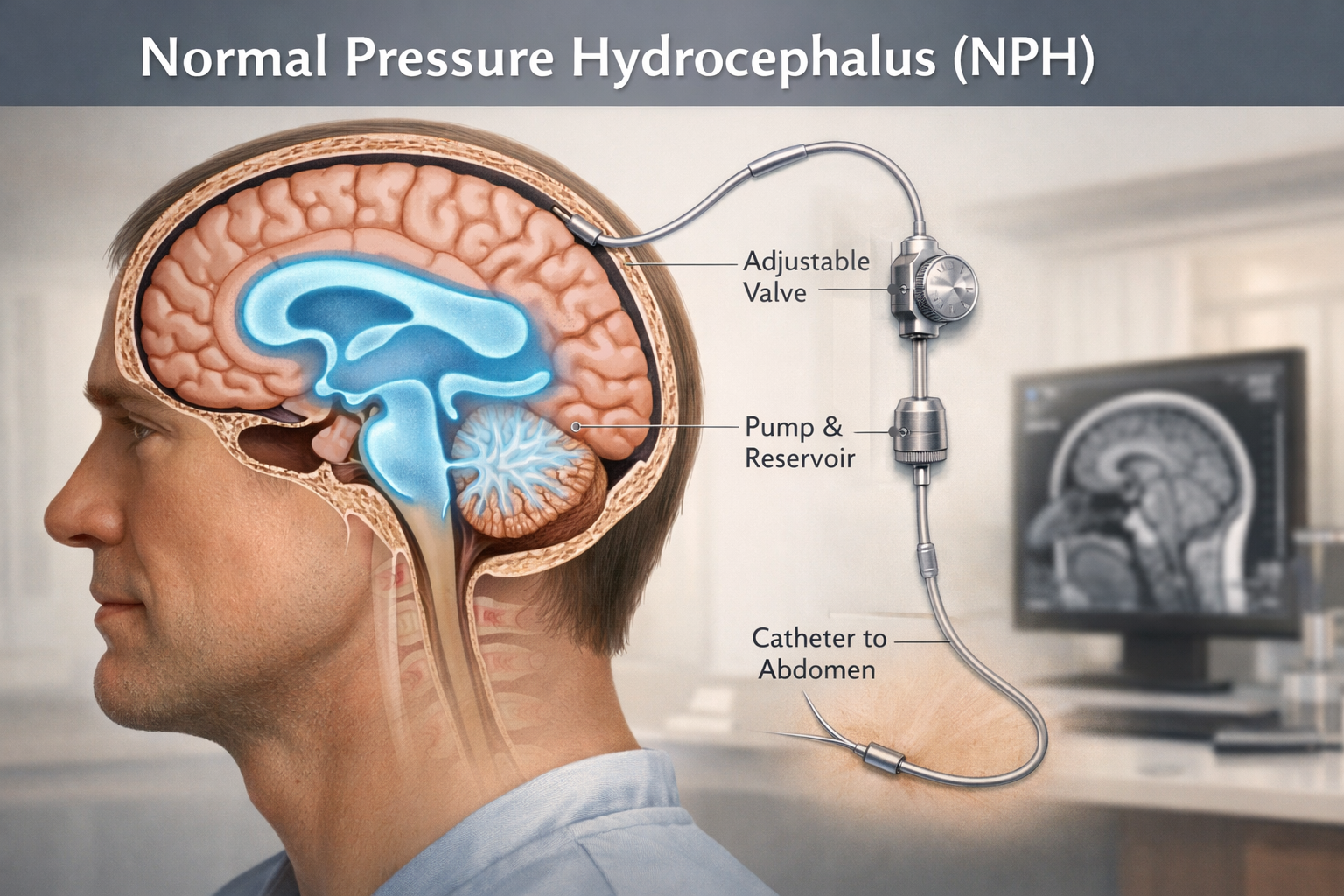
Normal-pressure hydrocephalus is characterised by an abnormal accumulation of cerebrospinal fluid (CSF) in the brain's ventricles. What distinguishes this condition is that, despite the increased volume of fluid, intracranial pressure remains within normal or only intermittently slightly elevated ranges. This ventricular dilatation exerts mechanical pressure on adjacent brain structures, altering their function and leading to a very specific symptomatology.
Symptoms and differential diagnosis of hydrocephalus in adults
The clinical suspicion of normal pressure hydrocephalus is traditionally based on the presence of the so-called «Hakim's triad», a set of three cardinal symptoms that usually appear progressively. Identifying these signs in time is crucial to prevent neurological damage from becoming permanent.
Hakim's Triad: gait, incontinence, and cognition
The first symptom to appear is usually the gait disturbance. The patients exhibit a characteristic gait: short steps, a wide base of support, and a sensation of the feet being «stuck to the floor» (magnetic gait). This symptom is often mistaken for joint problems or Parkinson's disease.
Secondly, it appears the Cognitive decline. This manifests as slow information processing, a lack of attention, apathy, and short-term memory failures. Families often attribute these changes to «normal aging» or Alzheimer's disease, delaying correct diagnosis.
Finally, it develops the urinary incontinence. Initially, the patient experiences frequent urinary urgency, which can progress to complete loss of sphincter control. The presence of these three elements in an elderly patient should always warrant a specialist consultation in neurosurgery.
The challenge of accurate diagnosis
At Arráez Institute, we employ advanced diagnostic protocols to confirm HNT. In addition to the Magnetic Resonance Imaging (MRI) to observe ventricular dilatation, we perform dynamic tests such as the infusion test or the Large-volume lumbar puncture (Tap Test). If the patient experiences a transient improvement in their gait after CSF removal, the chances of success with surgery are very high.
The role of shunts in treatment
Once the diagnosis is confirmed, the treatment of choice is the implantation of a cerebrospinal fluid shunt system. This intervention aims to drain excess fluid from the cerebral ventricles into another body cavity where it can be reabsorbed, usually the peritoneum (ventriculoperitoneal shunt).
Programmable valve technology
Modern neurosurgery has advanced significantly in the design of these devices. We currently use programmable valves that allow the drainage pressure to be adjusted externally, using a magnetic device, without the need for further interventions. This is essential for tailoring the treatment to the changing needs of each patient and avoiding complications such as over-drainage or under-drainage.
Results and functional recovery
The response to treatment is usually very satisfactory, especially concerning gait. Many patients regain the ability to walk independently and experience a noticeable improvement in their cognitive functions and sphincter control. The key to success lies in early intervention; The sooner pressure is relieved from the brain tissue, the better the long-term functional prognosis.
In the Arráez Institute, We perform this procedure using minimally invasive techniques and navigation systems that ensure maximum accuracy in the placement of the ventricular catheter. Post-operative monitoring is close, ensuring that the valve functions optimally and that the patient receives the necessary rehabilitative support to maximise their recovery.
Objective: to restore quality of life
Normal pressure hydrocephalus presents a treatment opportunity in a group of patients who might otherwise be misdiagnosed with incurable dementias. It is a condition where functional neurosurgery demonstrates its ability to restore autonomy and dignity to the elderly.
If you or a family member are experiencing walking difficulties, changes in memory, or urinary problems, it's essential to seek an expert assessment. A timely diagnosis can make the difference between progressive deterioration and the recovery of an active and fulfilling life.