
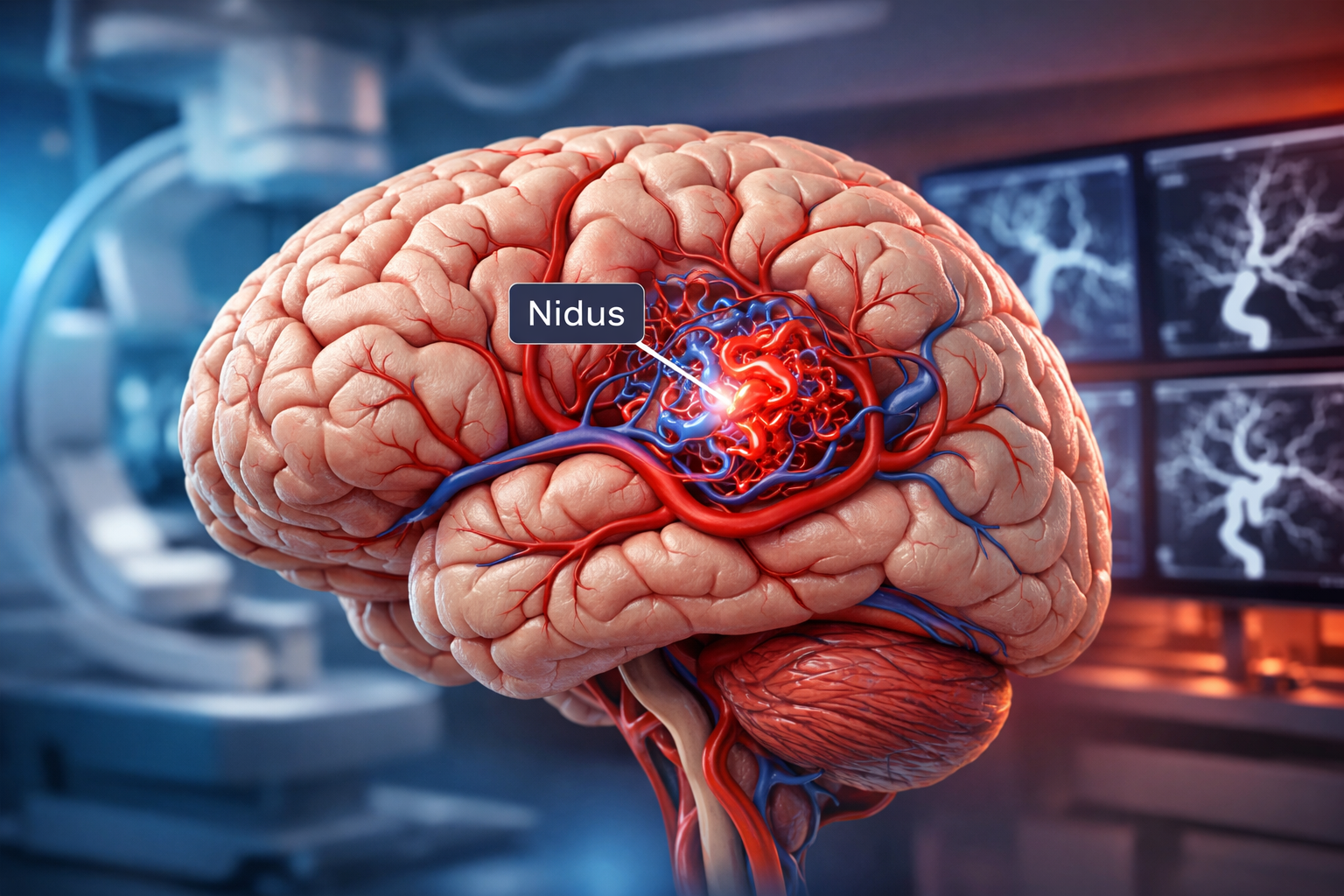
Cerebral arteriovenous malformations (AVMs) represent one of the most complex and fascinating pathologies within the field of vascular neurosurgery. These are congenital anomalies consisting of a direct and anomalous connection between arteries and veins, without the interposition of a normal capillary bed. This structure, termed a «nidus,» subjects the cerebral veins to elevated arterial pressures for which they are not designed, leading to a significant risk of rupture and intracranial haemorrhage. At the Arráez Institute, we address this challenge through a multidisciplinary strategy combining clinical expertise with the most advanced technology.
Although AVMs may remain asymptomatic for years, they are usually detected following an episode of cerebral haemorrhage, seizures or chronic headaches. The risk of bleeding is estimated at 2–4% per year, and each haemorrhagic episode is associated with significant morbidity and mortality. Consequently, the management of these lesions requires a thorough assessment to determine the risk-benefit balance of any intervention.
Diagnostic imaging of arteriovenous malformations
Accurate diagnosis is the critical first step in the management of an AVM. The architecture of these lesions is unique to each patient, necessitating the use of high-resolution imaging techniques to map the nidus, identify feeding arteries, and understand the venous drainage pattern.
The Importance of Digital Angiography
At the Arráez Institute, Digital Subtraction Cerebral Angiography remains the fundamental test. This procedure allows us to visualise blood flow dynamics in real time, identifying weak points such as aneurysms associated in the feeding arteries or stenosis in the draining veins, factors that increase the risk of rupture. We complement this information with functional Magnetic Resonance Imaging (fMRI) and Tractography to assess the relationship of the AVM with eloquent areas of the brain responsible for language, movement, or vision.
Classification and stratification of risk
We use standardised classification systems, such as the Spetzler-Martin scale, to categorise the complexity of AVMs based on their size, their location in critical areas and their drainage pattern. This stratification is essential for deciding whether treatment should be conservative, surgical or a combination of various modalities.
The multidisciplinary team at Arráez Institute for the management of AVMs
Given the complexity of these injuries, treatment rarely relies on a single technique. At our centre in Málaga, success lies in the close collaboration between vascular neurosurgeons, interventional neuroradiologists, and radiosurgery specialists.
A Three-Pronged Approach
Modern treatment of AVMs is usually multimodal. Endovascular embolisation is frequently used as a preparatory step for surgery or radiosurgery. Through microcatheters, liquid embolic agents (such as Onyx) are introduced to reduce blood flow within the nidus, facilitating safer surgical excision or improving radiation efficacy.
Microsurgery remains the definitive treatment for many AVMs. Under microscopic vision and with the support of intraoperative neurophysiological monitoring, Dr. Arráez and his team proceed with the meticulous exclusion of the feeding arteries and complete resection of the nidus, always preserving the normal venous circulation of the brain.
For those AVMs located in areas of very high surgical risk or small size, radiosurgery CyberKnife It offers a non-invasive alternative. The radiation induces a biological response that causes the abnormal vessels to close off gradually over a period of several months or years.
Commitment to patient safety
In the Arráez Institute, Each case is discussed by a vascular committee to design the safest and most effective therapeutic plan. Our aim is not only to eliminate the AVM but to protect the patient's functional integrity. The combination of techniques allows us to treat lesions that only a few years ago were considered inoperable, offering a new health outlook for our patients.
Conclusion: Seek excellence in vascular neurosurgery
The management of cerebral arteriovenous malformations is a testament to the advances in modern medicine. The integration of microsurgery, endovascular intervention and robotic radiosurgery makes it possible to treat these lesions with unprecedented precision and safety.
If you have been diagnosed with an AVM or are experiencing symptoms that suggest a cerebrovascular condition, it is essential that you entrust yourself to a team with extensive experience and technological resources. At the Arráez Institute, we are prepared to offer you the most advanced and personalised treatment in Málaga.
The treatment of AVMs requires a high level of specialisation. Trust the experience of the Arráez Institute in Málaga.