
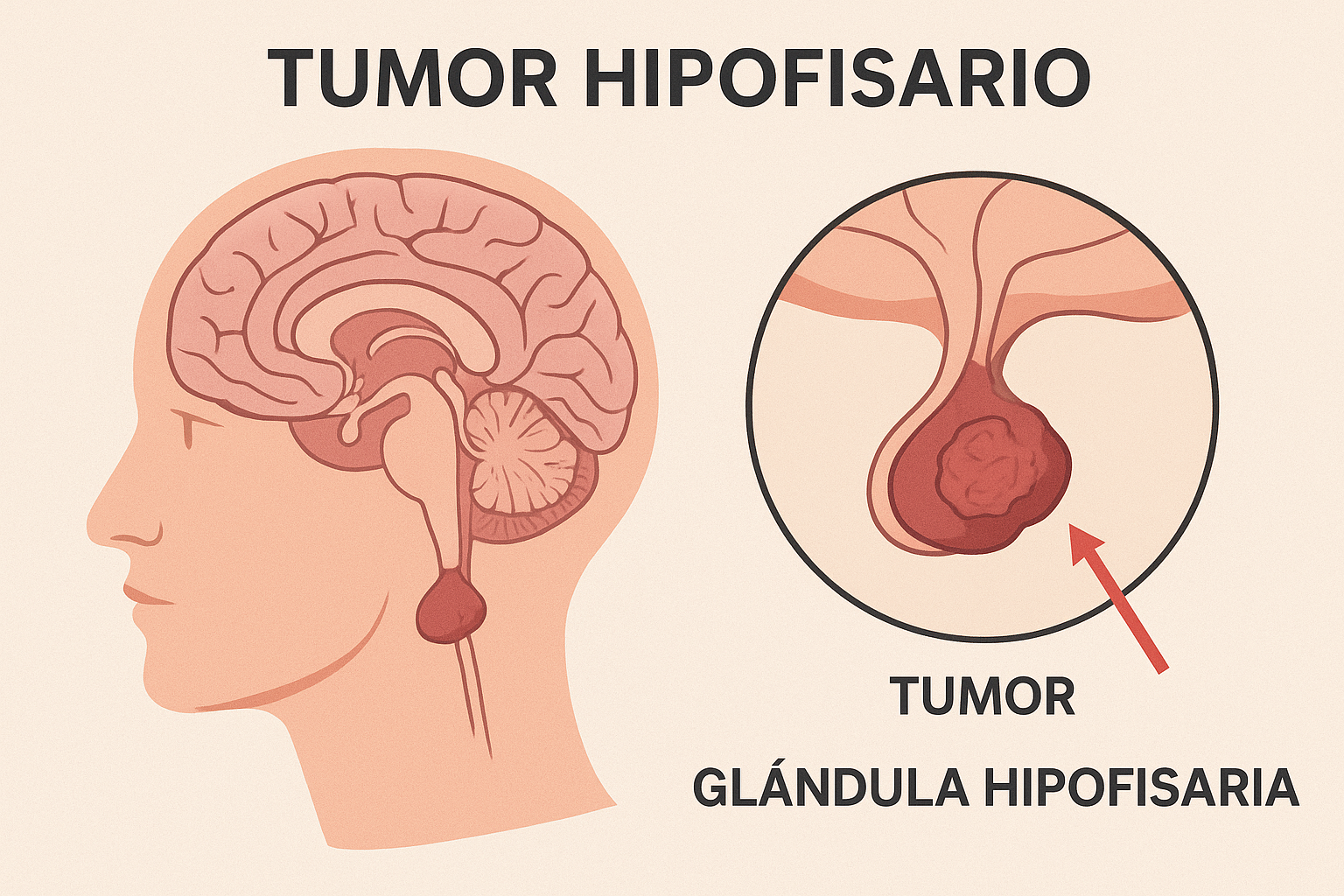
Today, we will discuss how endoscopic techniques have revolutionized the approach to pituitary tumors, offering a minimally invasive alternative to traditional surgery. This procedure allows neurosurgeons to access the pituitary gland through the nasal passages, avoiding cranial incisions and significantly reducing surgical trauma. The evolution of this technique has been fundamental in improving clinical outcomes and patients' quality of life, making it a gold standard in many specialized centers.
What are pituitary tumors?
Pituitary tumors are abnormal growths that develop in the pituitary gland, a small structure located at the base of the brain, just behind the eyes and below the hypothalamus. Although the vast majority of these tumors are benign (non-cancerous), they can cause a variety of health problems due to their strategic location and the pituitary gland's function. This gland is crucial for controlling many bodily functions, including growth, metabolism, reproduction, and the stress response, through the production and release of hormones.
Tumors can be classified into two main categories:
- Functional tumorsthey produce an excess of one or more pituitary hormones, leading to specific syndromes such as Cushing's disease (excess cortisol), acromegaly (excess growth hormone), or prolactinoma (excess prolactin). Symptoms vary depending on the hormone affected and may include weight changes, menstrual irregularities, vision problems, or abnormal growth of hands and feet.
- Non-functioning tumors those that do not produce excess hormones, but can cause symptoms by growing and compressing nearby structures, such as the optic chiasm, resulting in vision problems (loss of peripheral vision or double vision). They can also affect pituitary function by displacing hormone-producing cells, leading to hormonal deficiencies.
The Early diagnosis is crucial and often involves a combination of imaging tests (MRI), blood tests to measure hormone levels, and ophthalmological evaluations. The complexity of these tumors underscores the need for a multidisciplinary approach in their management.
Endoscopic surgery: step-by-step procedure
Endoscopic transnasal surgery for pituitary tumors is a highly specialized procedure performed under general anesthesia. The process is carried out with the utmost precision and can be broken down into several key stages:
- Nasal access The surgeon, often in collaboration with an otolaryngologist, inserts an endoscope (a thin, flexible tube with a high-definition camera and a light source) through one of the nostrils. No external incisions are made on the face.
- Image-guided navigation: Using advanced navigation systems, similar to surgical GPS, the medical team guides the endoscope through the paranasal sinuses (air cavities behind the nose) until it reaches the sphenoid bone, located at the base of the skull, directly below the pituitary gland.
- Sphenoid bone opening A small opening is made in the sphenoid bone to access the sella turcica, the bony structure that houses the pituitary gland and the tumor. This opening is large enough to allow the passage of surgical instruments, but small enough to minimize trauma.
- Tumor removal: Through the endoscope, specialized microsurgical instruments are introduced. The surgeon visualizes the tumor on a high-resolution screen and carefully removes it, preserving as much healthy pituitary tissue and surrounding nervous structures, such as the optic chiasm, as possible. The magnified vision and direct illumination provided by the endoscope are crucial for this precision.
- Reconstruction Once the tumor is removed, the base of the skull is reconstructed to prevent cerebrospinal fluid leaks and other complications. This may involve using tissue grafts from the patient's own body (e.g., fat or fascia from the thigh) or synthetic materials.
This meticulous and minimally invasive approach is what distinguishes endoscopic technique and contributes to its excellent results.
Benefits over conventional surgery
The advantages of endoscopic technique are numerous and have been widely documented in medical literature. At Arráez Institute, we have observed that these include:
- Less invasiveness By not requiring a craniotomy (opening of the skull), surgical trauma is significantly reduced. This results in smaller incisions, less damage to surrounding tissues, and less visible scarring.
- Less postoperative pain: Trauma reduction is directly associated with a decrease in postoperative pain, often allowing for less reliance on potent analgesics.
- Shorter hospital stay: Patients often recover more quickly and can be discharged from the hospital in a significantly shorter period of time compared to open surgery, often in as little as a few days.
- Faster recovery: the return to daily and work activities is considerably faster, allowing patients to reintegrate into their normal lives in a shorter timeframe.
- Better visualization of the surgical field The endoscope provides an enlarged, high-definition, and directly illuminated view of the tumor and adjacent structures. This allows for more complete tumor removal, even in difficult-to-reach areas, and greater preservation of healthy tissues.
- Lower risk of complications: And the precision of the endoscopic technique and the minimization of trauma reduce the risk of intraoperative and postoperative complications, such as hemorrhages, infections, or damage to vital nervous structures.
Recovery time and expected results
Recovery time after endoscopic surgery for pituitary tumors is generally shorter and less complex than with open surgery. Immediately after surgery, patients are closely monitored to ensure an uneventful recovery. Most patients can expect:
- Early hospital discharge As mentioned, many patients can go home in 2-4 days, depending on the complexity of the surgery and their general health status.
- Symptom reliefPatients usually experience significant symptom improvement in a short time, especially those related to optic chiasm compression (vision problems) or excessive hormone production.
- Hormone normalization In cases of functioning tumors, successful removal can lead to normalization of hormone levels, which in turn resolves associated syndromes.
- Improving quality of lifeThe ultimate goal is to restore the patient's quality of life, allowing them to resume their daily, work, and social activities more normally and without the limitations imposed by the tumor.
It is important to highlight that Full recovery can take several weeks or months., and regular follow-ups with the medical team may be required to monitor hormone levels and perform imaging tests to ensure the tumor does not reappear.
Cases in which it is not recommended
Although endoscopic technique is highly effective and considered the first-line approach for most pituitary tumors, there are specific situations where it may not be the most suitable option or where other surgical approaches or complementary treatments are preferred. These include:
- Large tumors with significant extension: When the tumor is exceptionally large and has spread to critical areas of the brain that are not accessible via the transnasal approach, such as the temporal lobes or brainstem, open surgery (craniotomy) may be necessary for safe and complete removal.
- Unfavorable nasal or sinus anatomy: In some patients, the anatomy of the nasal passages or sinuses may be too narrow or have abnormalities that make safe access for the endoscope and surgical instruments difficult. In these cases, alternatives are evaluated.
- Tumors with specific invasive characteristics: Certain types of pituitary tumors can be very invasive and adhere firmly to important vascular or neural structures, making complete endoscopic removal more challenging or risky. In these scenarios, a combination of approaches or adjuvant treatments such as radiotherapy may be chosen.
The decision on the most appropriate surgical approach It is always taken individually, after an exhaustive evaluation by a multidisciplinary team of specialists, including neurosurgeons, endocrinologists, radiologists, and ophthalmologists. At Instituto Arráez, we ensure that each patient receives the most appropriate treatment plan for their specific condition.
At Arráez Institute, we invite you to schedule an appointment with our neurosurgery team to assess your case personally and propose the most advanced and suitable solutions for their needs.